From the walls of Pompeii to the digital screens transforming the world’s metropolises
The history of advertising is as old as humanity’s need to trade and to communicate with the widest possible audience. Long before digital screens or static outdoor ads, archaeological finds document the use of public space to display commercial, political and informational messages as far back as antiquity.
The history of outdoor advertising is, in reality, the history of humanity’s relationship with public space: how we perceive its significance and how we interact with it.
From India to Athens and Pompeii

The Egyptians carved hieroglyphics into obelisks in order to address messages to travelers and merchants.¹ Around the same period, the Indus Valley Civilization also left traces of early outdoor advertising at the archaeological site of Dholavira, dating between 3000 and 1500 BC.² This find, an inscription of ten large gypsum symbols set on a wooden board nearly three meters long, is considered by many researchers to be the oldest known public “signboard” in the world.²¹ ²⁴
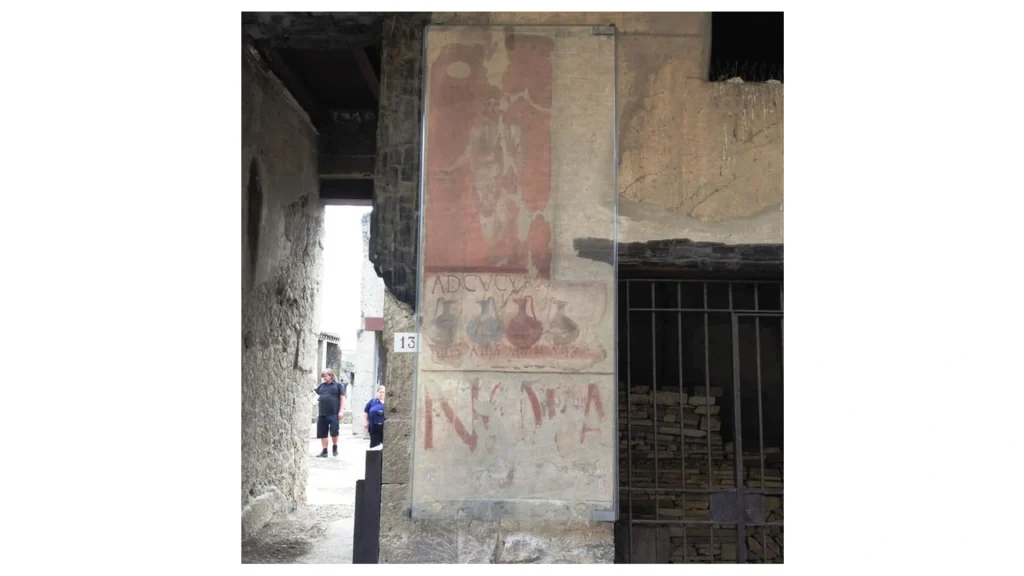
The use of inscriptions and public signs as a means of communication was also widespread across the ancient Greek and Roman world. According to Preston (1971), various forms of advertising messages, including inscriptions on walls, have been found in ancient cities such as Ur, Babylon, Rome, Athens, Pompeii and Carthage. The ancient Greeks used columns and posts bearing signs to record the order of events at public games (OAAA, 1992), while in Pompeii numerous inscriptions and painted messages have been found on public walls, informing residents about products, services and public events.¹ ³ ²⁵
In other words, we see regions that may or may not have developed trade relations with one another using the same way of communicating their messages. Different languages, different cultures, one shared need: to carry the message to where people are. From antiquity to the present day, humanity has operated on the same logic. Important messages that must spread quickly are displayed in public space.
From antiquity to the Middle Ages
In the Middle Ages, people continued to use public space as a medium for advertising and informational messages, as in 12th century France, where announcements of laws were posted in towns (Presbrey, 1929), while in the 14th century businesses were required to display a sign identifying their line of trade (Tocker, 1969).¹
London and the birth of commercial outdoor advertising
The first outdoor advertising structure for commercial purposes appeared in London in 1740, when a clothing merchant in the city asked for permission to post his own notices next to the official announcements (Presbrey, 1929).¹ The city council approved the practice, while at the same time introducing a fee for the use of this public medium. Shortly afterwards, advertisers began building their own posting surfaces in locations with heavy foot traffic (Sampson, 1874).
The early history in the USA
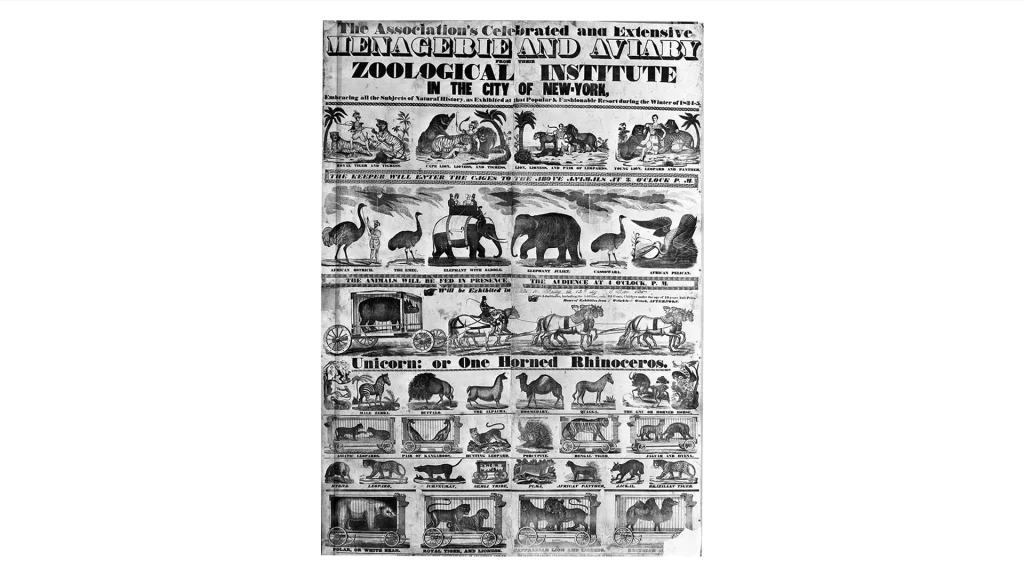
As poster techniques steadily gained ground in Britain, they were enthusiastically adopted on the other side of the Atlantic as well. In the 1830s, Jared Bell printed the country’s first large, colorful posters in New York, mainly to advertise traveling circuses. These posters are considered the forerunner of the modern billboard.⁴ ²⁶
It is no coincidence that the first truly large American “billboard” was born out of the world of entertainment, a relationship that would grow much deeper in the years to come. Because OOH has always been an art form.
The early 20th century: the automobile and Times Square
In 1916, New York City passed an ordinance regulating land use, introducing local zoning control and marking the beginning of the billboard era in Times Square (Charyn, 1986).⁵
A few years later, we are now living in the age of Fordism: production capacity increases, costs fall, and consumers turn en masse to the automobile industry.
With the boom in car ownership in the 1920s, mobility became a trend and billboards began to multiply along the roads.⁴ The growth of personal travel and of the road network created new roadside landscapes, some of which, like Route 66, the legendary American highway, were used as sites for outdoor advertising (Caton & Santos, 2007).⁵
The creation of the first animated sign
In 1937, the advertising man Douglas Leigh unveiled in Times Square the first animated electric sign, a structure with 2,000 light bulbs showing a galloping horse and cats playing with balls.⁴ ²⁷
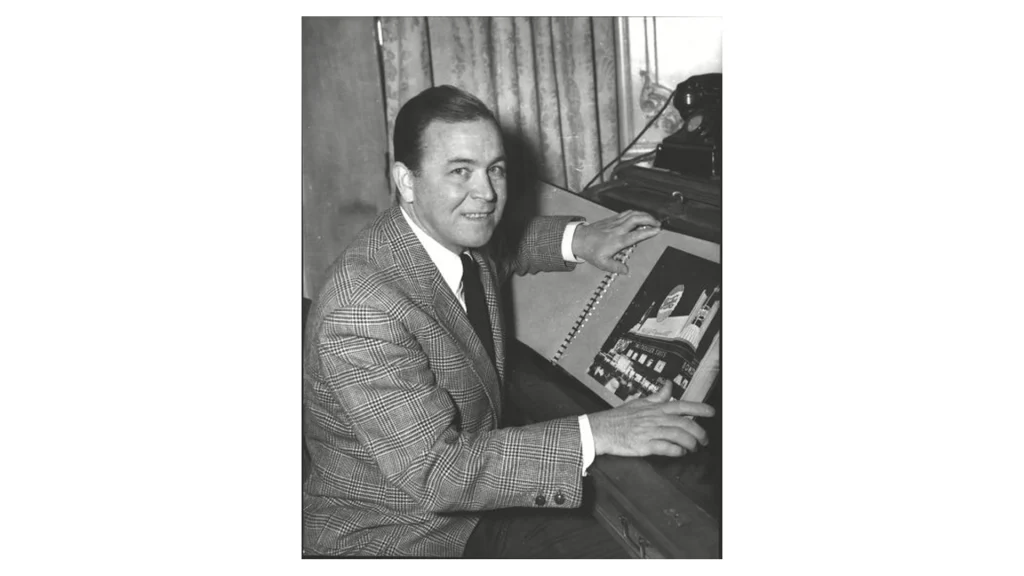
By the end of the decade, Leigh had already filled the façades of Times Square’s buildings with bright, spectacular signs, gradually shaping the character the square retains to this day.⁴
This was the era when Coca Cola, partly through OOH, managed to make Santa Claus synonymous with its brand. Haddon Sundblom’s illustrations of the distinctive bearded, smiling Santa dressed in red played a decisive role in spreading worldwide the image we now take for granted. His depiction through outdoor advertising contributed significantly to cementing this particular image in mass culture.⁶
From the 1970s to the 1990s:
In 1976, Douglas Leigh installed on the façade of the Times Tower the first full color, electronically programmable advertising panel, known as “Spectacolor”, using technology devised by George Stonbely, founder of the company of the same name, a year earlier in 1975.⁴ ²² ²³
The sign had more than 8,000 light bulbs and could display text, color graphics and animations. The step from the static sign to the moving digital image was now complete; everything that followed was, essentially, an improvement in resolution.⁴
Towards the end of the 1990s, the first LED signs appeared and gradually began to replace traditional painted or printed structures, while in the same decade the first billboard with digitally generated graphics came onto the market.⁴ ²
Entering the 21st century
During the first decade of the 21st century, the rapid development of digital technology split the outdoor advertising market into two sectors: one that continued to offer traditional outdoor advertising in all its forms and sizes, and a new sector dedicated to digital billboards and large format screens, known as DOOH (Digital Out of Home) advertising.⁴
In the 2010s, digitalization continued to bring impressive developments, such as the use of geolocation data, interactive screens, mobile device sensor technologies and ultra high definition displays.⁴
Today: when the billboard becomes a landmark
Today, certain outdoor advertising sites are no longer content with their pioneering character as advertising media; they have become tourist destinations in their own right, where visitors flock specifically to see them and have their photo taken in front of them. City guides, social media trends and articles recommend a visit to outdoor advertising sites in the world’s great metropolises.
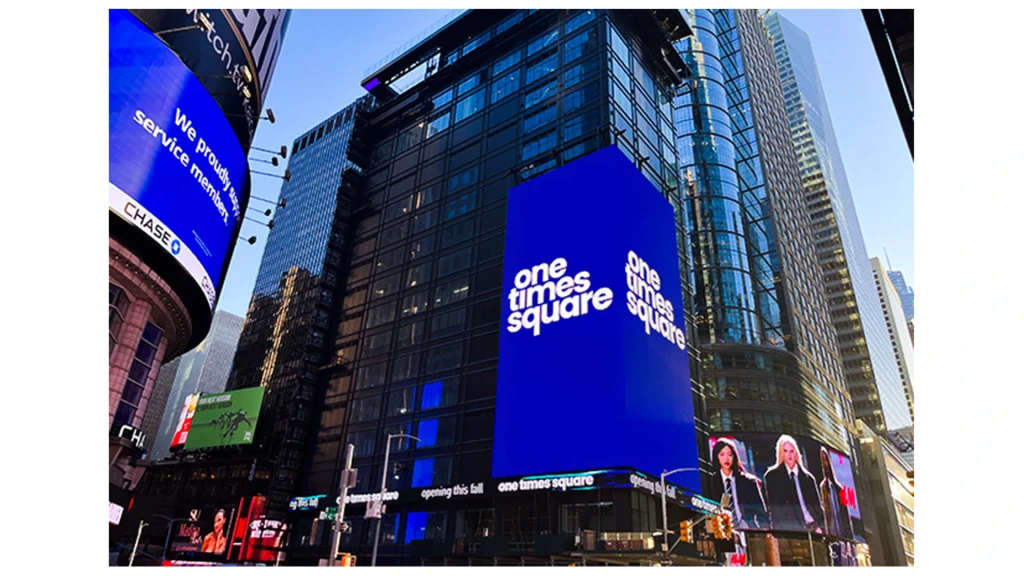
Times Square, New York
We begin with the most popular landmark of outdoor advertising, Times Square. The square sees around 380,000 pedestrians every day, while 1.5 million advertising impressions are delivered daily; in fact, the One Times Square screen is considered the most photographed sign in the world.⁷ ²⁸
And now the most famous sign in the world can “host” anyone, since every visitor, by purchasing a service, can see their own photo on the Times Square screen.⁸ A must for every visitor to New York.
Major brands such as Spotify create content around the square’s screens, and these ads go viral around the world.⁹ Because in the end, their outdoor advertising becomes a point of reference both in the press and on social media. The power of physical space manages to carry the message horizontally, across every medium.

Shinjuku, Tokyo
Tokyo’s “answer” to New York came through illusion. In the Shinjuku neighborhood, a curved 3D LED screen dominates the scene, positioned opposite the east exit of the station of the same name, using its curvature to create a stunning illusion of depth. Its most famous “image” is a hyperrealistic calico cat that seems to live on an “imaginary balcony”, meowing and watching passersby. Brands such as Nike, Louis Vuitton and Pokémon have already used it, turning it into one of the most popular selfie spots in the world.¹⁰ ¹¹ ²⁹
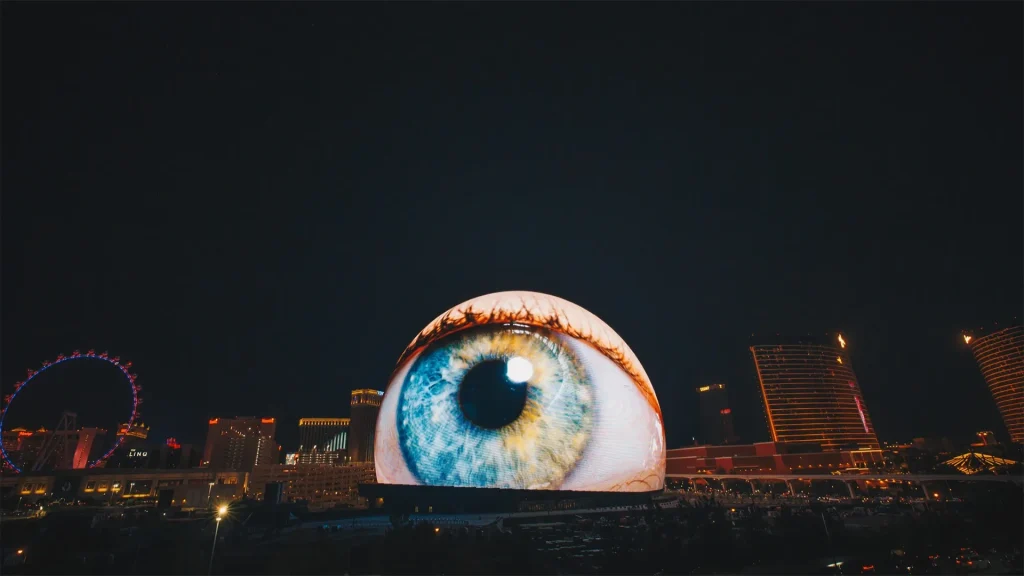
The Sphere, Las Vegas
Where Tokyo bent the flat screen to create depth, Las Vegas decided to have no flat screen at all: it turned an entire building into a single screen. “The Sphere” is a spherical building whose exterior surface is covered in programmable LED lighting. Visible from much of the city, it has become a destination for tourists to visit and photograph.¹² ³⁰
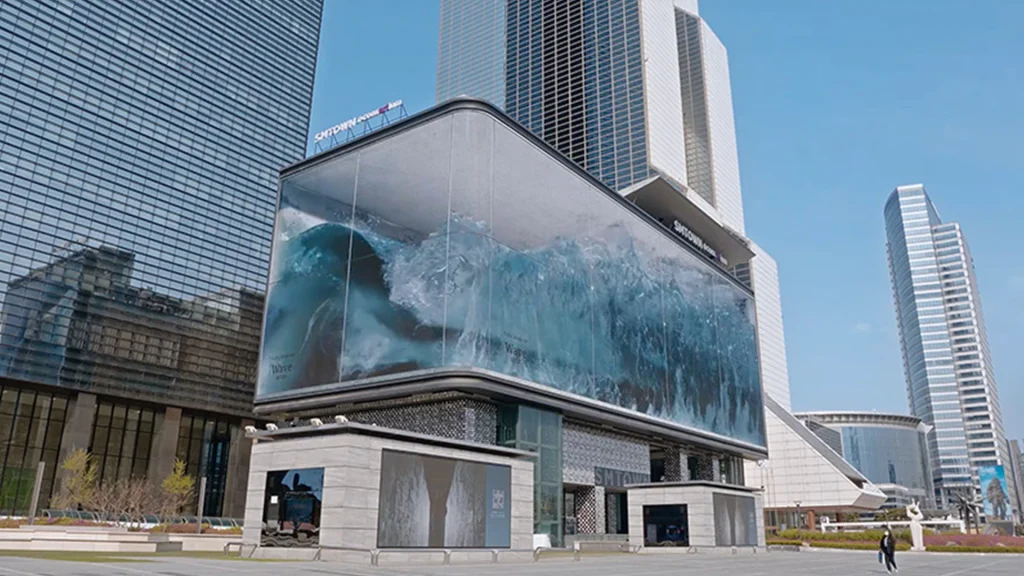
COEX Plaza, Seoul
In Seoul, the SMTown Media Facade outdoor digital screen on the COEX Artium building has been operating since 2018, with a clear goal: to turn the area into the “Korean Times Square”.¹³
Its fame skyrocketed in 2020, when the “Wave” installation created the illusion of a wave crashing inside a glass tank on the building’s curved façade. An ad so convincing that it went viral, with passersby stopping in droves to film it and share it on their social media feeds.¹⁴ ¹⁵
Piccadilly Lights, London
In the city where outdoor advertising first began to take on its modern characteristics, London, Piccadilly continues to take center stage.
Piccadilly Lights dates back to 1908, when the first illuminated advertising sign was installed there.¹⁶ ¹⁷ The popularity as a tourist attraction of the large single digital screen installed ten years ago is also borne out by the numbers: around 100 million people pass through the square every year.¹⁸ ³¹
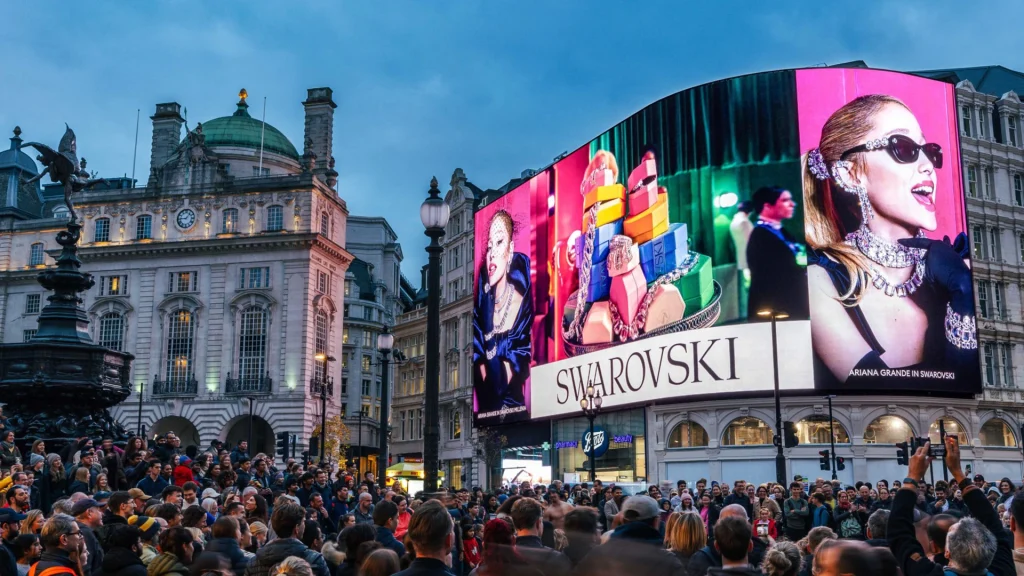
In all five cases, the conclusion is the same. You don’t go just to see the ad; you go to see the place itself. That is what draws visitors who want to see it and have their photo taken in front of it. Because here, DOOH becomes a landmark. And the advertising it displays becomes part of the tourist’s experience; it becomes the memory of a trip.⁵
Outdoor advertising in Greece today
New York, Seoul, London, Tokyo. Advertisers no longer simply choose to place their ads where the people are. Now, people visit the places where the ads are. Outdoor advertising stops being only a medium and becomes the destination. Where does Athens stand in this trend?
This shift is not limited to the great metropolises abroad. The same evolution is now visible in Greece as well, where the OOH market is gradually moving from a logic of simple display to one that reshapes the urban landscape.
Politis Group’s most recent move to install DOOH screens confirms this trend on a national scale. With the installation of state of the art digital screens along Attica’s most central road arteries, the largest continuous DOOH (Digital Out of Home) network in Europe is being created, reshaping the urban landscape of the Greek capital.
With a wide range of options such as the Digital Big Billboard, the DOOH Billboards Network, DOOH Real Time, DOOH Wraps and the iconic Synchro screens at Syntagma and OAKA, Politis Group succeeds in aligning the Greek market with current trends in the world’s metropolises.
Beyond advertising content, the screens also play an important role in the city’s daily life, as they provide the time, the weather, wildfire alerts, traffic updates, emergency announcements and other public interest services.
“Outdoor advertising is evolving, and we are leading this transformation. With this investment, we are strengthening our network and offering our partners a modern, smart and effective promotional environment,” said Mr. Haris Politis, Chairman of Politis Group.²⁰
Outdoor advertising: timely in every era
In the end, we see how, from the era of wall paintings to that of paper and finally to the modern world of FM radio, television and the internet, outdoor advertising manages to hold a leading role. Its resilience certainly rests on its adaptability to new technologies. From large static posters it moved to digital screens and, most recently, to anamorphic 3D displays.
However, updating a medium is not, in itself, enough to ensure its survival. Outdoor advertising manages not merely to survive but to play a leading role in people’s daily lives across the centuries, because public space is where human communication began. It is where people have lived together and communicated in harmony since the dawn of history.
No matter how many screens we carry every day in our pockets or bags, none can reproduce what the street and the square offer: a shared experience lived by thousands of people at the same moment and in the same place. While the screens of our smart devices isolate us, a screen at Syntagma or Piccadilly connects us. Because it does not speak to one person, but to an entire city. This sense of collectivity turns advertising into a shared experience, into a memory for the city’s people.
From the inscriptions of Pompeii to today’s digital screens, outdoor advertising has relied on something unchanging: the human need to live together, to share our space with others.
As long as there are streets, squares and people crossing them together, there will be outdoor advertising, not as a mere display medium, but as an integral part of city life.
References
Πηγή (1): Taylor, C. R., & Chang, W. The History of Outdoor Advertising Regulation in the United States. Villanova University.
Πηγή (2): Vigyapan Mart. . Everything you should know about the history of outdoor advertising.
Πηγή (3): Rehman, F. ur, Javed, F., Md Yusoff, R., Harun, A., Khan, A., & Ismail, F. (2019). What is advertising? A short review of historical development.
Πηγή (4): Caceres, P. OUTSITE brings you the history of OOH in 15 amazing milestones. INSITE OOH.
Πηγή (5): Lowery, B. C. Outdoor Advertising: Landmark of the Experience Economy. Interdisciplinary Journal of Signage and Wayfinding, 3(2).
Πηγή (6): The Coca-Cola Company. Haddon Sundblom and the Coca-Cola Santas.
Πηγή (7): Times Square Alliance. Advertisement & Sponsorships. Times Square NYC.
Πηγή (8): Times Square Billboard / Welcome to Times Square. . Your Photo on Our Billboard. https://timessquarebillboard.com/
Πηγή (9): Billboard Insider. Spotify Offers “Share on a Billboard” Button to Premium Users.
Πηγή (10): Sienra, R. Watch Nike and Other Brands Take Over Tokyo’s 3D Billboard. My Modern Met.
Πηγή (11): Χονδρονικόλα, Μ. Οι 3D διαφημίσεις στο Τόκιο… είναι αλλού! Blackbook.
Πηγή (12): Sphere Entertainment. Sphere Immersive Shows, Concerts & Events in Las Vegas.
Πηγή (13): Cho, Y. Coex to operate Korea’s largest outdoor screen to feature K-pop content. The Korea Herald.
Πηγή (14): urdesignmag. D’strict Creates The World’s Largest Anamorphic Illusion In Seoul.
Πηγή (15): Lim, J. ‘Wave’ on Coex digital billboard grabs international attention. The Korea Herald.
Πηγή (16): Campaign UK / Ocean. Piccadilly Lights: 110 years of an ad landmark. Campaign Live.
Πηγή (17): Ciundziewicki, M. Once upon a Time at Piccadilly Circus, or about Advertising in London from many Years Ago… Jet Line.
Πηγή (18): Reeves, A. . Piccadilly Lights Overhauls Format to Triple Brand Domination. LBBOnline.
Πηγή (19): Politis Group. Out of Home.
Πηγή (20): Politis Group. The Largest Investment in DOOH Network in Greece by Politis Group.
Πηγή (21): Business Today Desk. ‘World’s oldest-known Signboard’: Ministry of Culture shares ‘remarkable’ Indus discovery from Dholavira. Business Today.
Πηγή (22): Wikipedia. Douglas Leigh.
Πηγή (23): Wikipedia. George Stonbely.
Πηγή (24): Ministry of Culture, Government of India Ανάρτηση στο X
Πηγή (25): Ghost Signs.. Signs & Frescoes in Pompeii & Herculaneum.
Πηγή (26): Journal of Antiques and Collectibles. The Bigger, The Bolder: Outdoor Advertising.
Πηγή (27): Shutterstock Editorial. Douglas Leigh, American advertising executive, neon light.
Πηγή (28): SNA Displays. One Times Square.
Πηγή (29): CNN Style. 3D cat billboard in Tokyo’s Shinjuku district.
Πηγή (30): The New Yorker. The Sphere and Our Immersion Complex.
Πηγή (31): Ocean Outdoor. Piccadilly Lights.