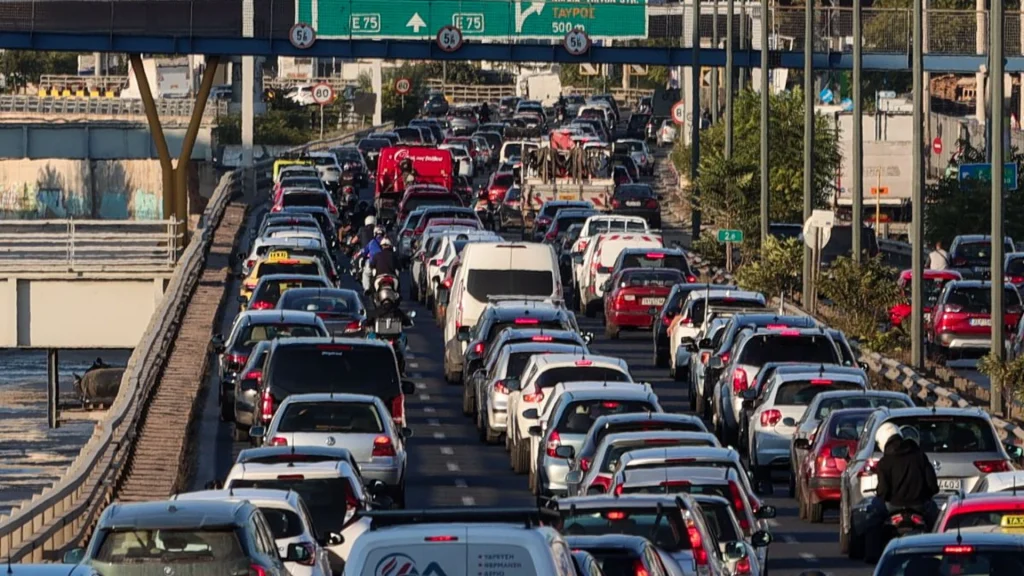
Athens is a city in constant motion. Every day, from early morning until late at night, millions of people move through its streets for work, shopping, entertainment, sports, dining, and social activities. This ceaseless movement translates into a huge, daily opportunity for brand exposure through outdoor advertising, Out-of-Home Advertising (OOH).
In today’s world of content consumption, there is a strong trend of audiences turning to subscription services to avoid having their experience interrupted by advertising content.
In the case of OOH, however, the way OOH reaches consumers works in exactly the opposite way. It is a natural part of their journey. Whether on foot or inside a vehicle, the consumer is not asked to interact with a screen, to interrupt their consumption of content, or to wonder how they were targeted by advertising; the ad simply meets them in the space where they move and live every day. So the biggest obstacle an advertiser faces, interrupting content, which is accompanied by negative feelings, has already been overcome.
Athens Is Moving. OOH Knows Exactly How Much
Today, the effectiveness of OOH is measurable, since it draws exclusively on data from independent providers, not from the media owner itself.
The evolution of data has changed the way we measure the impact of outdoor advertising. The development of the Location Intelligence Study (LIS) makes it possible to measure and analyze indicators such as Total Reach, Unique Reach, Impressions, Frequency, and Vehicles Impacted. In other words, we can turn the movement of the city into measurable media results.
What Is the Location Intelligence Study (LIS)
The Location Intelligence Study (LIS) combines data from three independent sources: two providers of vehicle and human mobility data (i.e. location data), and one geospatial analytics platform, creating a comprehensive set of OOH metrics.
In this way, we know how many people a campaign reaches, how often it reaches them, and in what environment, combining the power of mass exposure with the power of data.
A prime example is the LIS data for Vasilissis Sofias Avenue:
Over a 14 day period in June 2026, the analysis recorded 23,569,220 Vehicles Impacted and a Unique Reach of 1,240,638. These numbers fully capture the scale of the advertising opportunity created by an outdoor campaign on one of the most central arteries of Athens.
Reach, Frequency, and Dwell Time: Three Dimensions of the Same Journey
More specifically, on one of the most central streets of Athens, in just 14 days more than 23 million vehicle passages were recorded, while the number of unique individuals who passed in front of an OOH advertising site at least once corresponds to 32.5% of the permanent population of Attica (ELSTAT data, 2021 Population Census).
An important factor that strengthens the impact of an outdoor advertising message is the dwell time of the audience. Unlike other media, in the case of OOH the audience does not need to interrupt their consumption of other content in order to come into contact with the advertisement in the physical space.
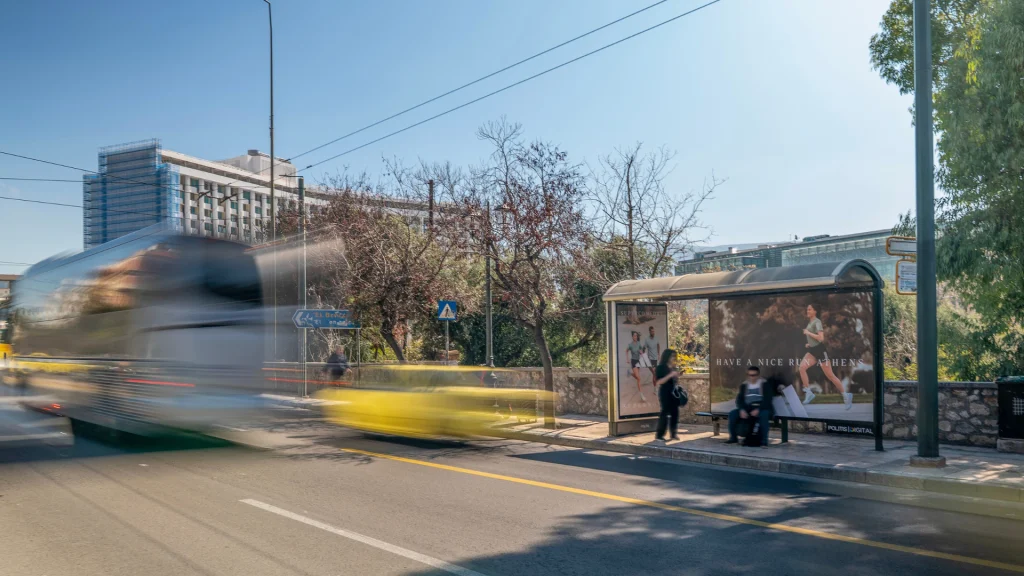
Consider a public transport user waiting 7 to 10 minutes for a bus. They are exposed to the advertising message throughout their entire wait, giving them time to process and engage with the campaign message.
As for vehicle drivers, according to TomTom mobility data, an average person driving during peak hours to cover a distance of 10 kilometers spends an average of 31 minutes inside their vehicle, with an average speed of 15 kilometers per hour. This characteristic makes the driver more receptive to consuming outdoor advertising content. Low speeds and the repetitive nature of the campaign create more opportunities for the audience to come into contact with the advertising message.
Multiple OOH advertising sites are positioned along these routes, increasing the frequency with which audiences encounter the message. This is why, in the case of Vasilissis Sofias Avenue, the Total Reach over 14 days reaches 32,233,530 individuals across all advertising frames on this particular road artery.
International research points to one key conclusion: advertising effectiveness increases through repetition.
The classic “3+ Effective Frequency” theory holds that at least three exposures are required before a message begins to make a meaningful impact on audience memory. The “Rule of 7” theory holds that a potential customer needs to come into contact with the message 7 times before proceeding to a purchase or other action.
At the same time, a meta-analysis published in the Journal of Advertising found that ad recall continues to increase up to at least eight exposures.
Taking into account international literature and current research, the frequency figures for an OOH campaign are impressive.
The average frequency recorded in outdoor campaigns over the course of a year reaches 8.6 contacts per person over a period of just 14 days.
The conclusion is simple: effective advertising is not based on a single impressive contact, but on a series of repeated contacts that gradually build memory and familiarity.
The increase in Opportunities To See (OTS) for the audience leads not only to repeated contact with the message, strengthening brand awareness, but ultimately also to the audience’s gradual familiarization with the brand and brand recall.
This repetition is especially important in everyday movement. People largely follow repeated routes: from home to work, from work to home, to shops, to entertainment venues. OOH can therefore meet the same audience again and again, within a familiar environment shaped by the patterns of their daily routes.
The Value of Public Space
Global research has concluded that consumers form an opinion about a product well before they actually consume it, specifically, from the moment they come into advertising contact with it. Traditional media have always given the advertiser a sense of credibility. The fact that the media outlets trusted by readers, listeners, and viewers for information advertised a particular product automatically transferred some of their own credibility and legitimacy to that product.
Dynamic audiences, however, for a variety of reasons, including the emergence of new technologies, political and social changes, and cultural shifts, are abandoning traditional media.
In the online world, on the other hand, advertisers generally do not gain credibility. The sheer volume of ads, the recipient’s heightened sense of being interrupted from their content consumption, and the presence of malicious, misleading, unregulated advertisements provide limited added value to the advertiser.
Outdoor advertising stands in contrast to this: advertising in public space, which is governed by specific legislation.
The rules set by lawmakers strengthen the advertiser’s credibility, and combined with the great added value that public space holds for citizens, the advertiser gains credibility. In fact, precisely because it takes place in public space, it can reach audiences that may otherwise be excluded, whether by their own choice (younger age groups who avoid traditional media, for example) or due to lack of familiarity (e.g. technological illiteracy among older age groups).
Research has in fact shown that outdoor advertising has a strong influence on the so called dynamic audience, since this is precisely the audience that is typically found in public space, whether commuting to and from work, shopping, or engaging in entertainment, and so on.
In the example of Vasilissis Sofias Avenue, 29.61% of the audience belongs to the 18 to 34 age group, while 19% each corresponds to the 35 to 44 and 45 to 54 age groups.
Athens Is Always Moving, and the Brand’s Message Moves With It
For a brand, Athens is a city in constant motion. It is not simply a collection of streets and locations.
Every brand can harness the power of physical presence in the city, while maintaining a clear picture of the audience it reaches and the performance of its campaign.
Ultimately, Athens is not just a city with a lot of traffic. It is one of the largest everyday media environments a brand could have at its disposal.