From the Attention Economy to the Trust Economy
For more than two decades, the advertising industry chased one thing: reach.
More impressions. More clicks. More data.
The digital ecosystem promised that every view could be measured, every user identified, and every advertising expense allocated with absolute precision.
Today, however, the conversation has changed.
The question is no longer just how many people saw a message. It is how many trusted it.
And in this new reality, Out Of Home (OOH) is emerging as one of the biggest winners. Not because technology has stopped mattering but because alongside measurement, targeting, and data, a factor we long took for granted is coming back into focus: trust.
The Digital World’s Trust Crisis
Digital advertising created unprecedented communication opportunities. But it also created unprecedented challenges.
However, not all digital environments are the same. There are digital media that maintain a high degree of control, both over the content they publish and the advertising environment they host.
A characteristic example is online press, where content is produced and controlled by editorial teams, follows journalistic editing processes, and is published under the responsibility of editors and journalists. Ad placements sit within a predetermined and controlled display environment, offering greater transparency and safety for both advertisers and audiences.
Digital advertising, however, extends far beyond online press. It includes social networks, audiovisual content platforms, search engines, and a broad ecosystem of automated ad space buying and distribution. In many of these environments the scale, automation, and sheer volume of content make it harder to fully control the context in which a message appears. As a result, the line between trustworthy and questionable content often becomes less distinct for the user, forcing them to try every day to tell apart:
- authentic content from AI generated content
- real people from bots
- legitimate ads from scams
- valid information from misleading messages
From scam ads using deepfake technology to mimic the faces and voices of celebrities, to the manipulation of public opinion through bots on social networks, civil society is calling for tighter internet oversight, as well as protection for younger generations, with the trend toward banning social media use by minors finding a receptive audience among governments around the world.
The result is a generalized trust crisis. And when trust declines, so does the effectiveness of communication.
The Hidden Cost of Digital Advertising
Perhaps the greatest contradiction of digital advertising is that while it is the most measurable advertising channel in history, it still faces serious verification problems.
According to international studies, financial losses from ad fraud exceeded $37.7 billion globally in 2024, while other estimates put the real cost above $60 billion annually.
In simple terms, tens of billions in advertising budgets are lost every year without ever reaching real consumers.
This may be the largest “value leak” in the history of the advertising industry.
Behind these numbers lies an entire parallel economy built on:
Bot Traffic
Automated programs visit websites and click on ads, simulating human behaviour.
Fake Impressions
Ads are displayed in environments that no real user ever sees.
Click Fraud
Artificial clicks are generated to drain budgets or illegitimately boost publisher revenue.
Domain Spoofing
Low-quality sites falsely present themselves as premium media.
Ad Stacking
Multiple ads are placed on top of one another, with only one theoretically visible.
In many cases, advertisers pay for impressions that no real person ever saw.
- They pay for clicks generated by software.
- They pay for audiences that don’t exist.
The conversation is no longer just about wasted budget. It is about the credibility of the ecosystem itself.
When Even the Platforms Admit the Problem
The world’s largest tech companies are now investing billions in fighting ad fraud.
Google blocks billions of malicious ads and millions of advertisers accounts every year.
Meta is constantly confronted with issues of scam ads and misleading content.
At the same time, the platforms themselves are being forced to apply increasingly strict verification processes for users and advertisers.
What does this mean in practice?
That part of the digital ecosystem still hosts accounts and activity that cannot be identified with absolute certainty.
Although platform restrictions are tightening, the ad fraud shadow economy persists. In financial terms, it is practically an empire, since, as mentioned, its revenues exceed 60 billion dollars annually.
For an advertiser, this translates into a real risk: part of the budget ending up on invalid traffic, fake impressions, or fraudulent activity instead of reaching real consumers.
And as uncertainty in the digital ecosystem grows, media that offer physical presence and transparency gain greater value.
OOH Belongs to the Physical World
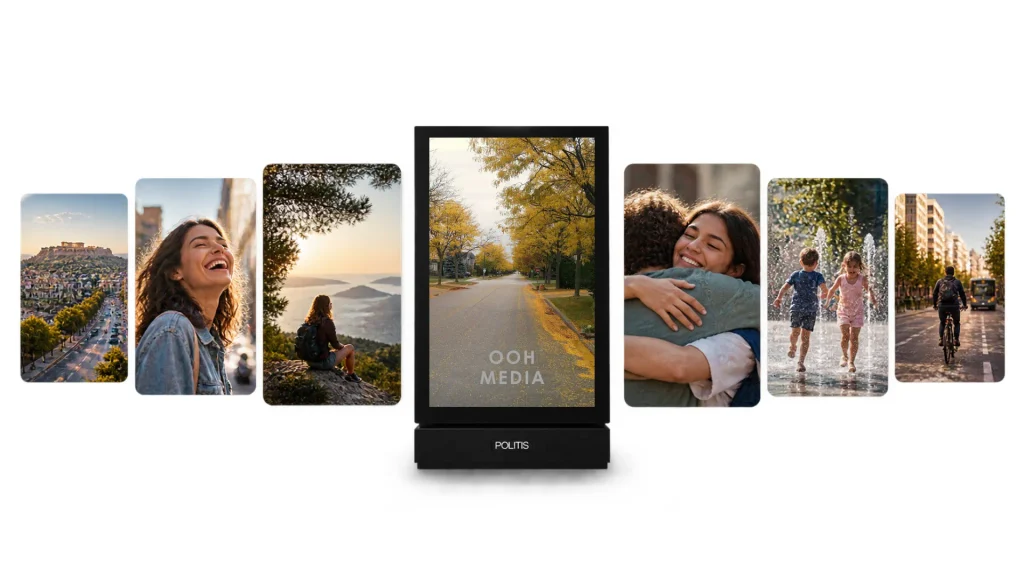
Outdoor advertising operates on an entirely different logic.
- It does not rely on cookies.
- It does not rely on user IDs.
- It does not rely on opaque algorithms.
- It does not rely on clicks.
The ad does not appear next to content that contradicts the advertiser’s values.
The ad stands in front of the consumer, in real space and real time. This creates a unique level of trust.
- The consumer knows the message they see is real.
- The brand knows its investment is visible.
- Both share the same physical experience.
- There are no bots on an avenue.
- There are no fake impressions at a bus stop.
- There are no click farms on a billboard.
- There are no ad exchanges buying and selling opaque inventory.
OOH offers something digital is constantly trying to prove:
Authenticity.
Why Consumers Trust OOH
Trust in OOH is not accidental. It stems from the medium’s fundamental characteristics.
It Is Public
An outdoor ad is exposed to everyone.
It cannot hide behind algorithms or opaque distribution mechanisms.
It Is Verifiable
The ad exists in a specific physical location. It does not rely on invisible impressions or questionable traffic. What the consumer sees is exactly what the advertiser paid for.
It Is Brand Safe
The display environment is known, controlled, and predictable.
It is non-intrusive.
It does not interrupt content.
It does not invade the user’s experience.
It Is Fraud-Free
Perhaps OOH’s greatest value today is that the audience seeing the ad is real.
It Is Democratic
Everyone sees the same message. At the same moment. In the same space.
This transparency builds credibility.
And credibility builds effectiveness.
The New Value for CMOs: Trust Media
For years, media planning relied on two key variables: Reach and Frequency.
Today, a third, equally critical parameter is being added: Trust.
For years, marketers invested in media based on CPM.
Today, more and more marketers are evaluating media based on a new KPI:
Trust per Impression.
- How trustworthy is the environment in which the brand appears?
- How confident is the advertiser that the message reaches real people?
- How positively does the consumer perceive the brand’s presence?
OOH answers all three questions.
That is why we are seeing renewed investment in the medium worldwide.
Not as an alternative to digital.
But as the foundation on which a credible omnichannel strategy can be built.
The Medium of the Next Decade May Be the Oldest One
The history of advertising is usually associated with innovation. But every technological leap also creates new risks.
In a digital world of AI-generated content, bots, deepfakes, and ad fraud, the greatest innovation may not be a new platform.
It may be a return to media that still offer something extraordinarily rare:
Trust.
OOH is not just a high-reach medium.
It is not just a high-visibility medium.
It is a high-trust medium.
And in an age where trust is becoming the most valuable currency in communication, OOH may hold the rarest trait a medium can offer:
It doesn’t need to prove it’s real.