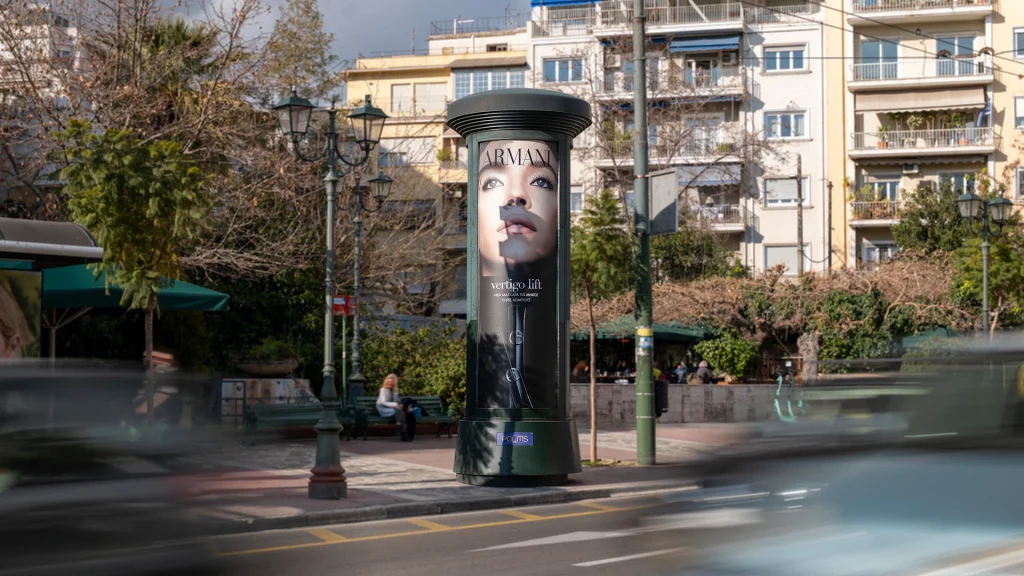
Digital Out-of-Home Advertising (DOOH) represents the digital evolution of outdoor advertising, replacing traditional static advertising surfaces with high-resolution digital screens. Through these screens, advertising content can be changed and scheduled digitally, allowing different creatives, messages and formats to be displayed on the same surface.
As a result, DOOH transforms outdoor advertising from a static message into a dynamic communication medium that can adapt to its environment and the context of the moment.
In Greece, DOOH is rapidly expanding across high-traffic locations such as shopping centres, airports and major roads, offering greater flexibility and strong visual impact.
Politis offers a variety of DOOH formats, including Digital Bus Shelters, Digital Big Billboards, Digital Billboard Networks, DOOH Real-Time and Syntagma Synchro.
Key Characteristics of DOOH
Remote Control and Digital Management
Unlike a static advertising surface, which requires the production, printing, physical installation and subsequent removal of advertising material, DOOH content can be uploaded and changed remotely through a digital content management platform.
This provides greater speed and flexibility throughout the entire campaign lifecycle.
- Content can be changed remotely, without any physical intervention at the screen.
- New creatives can be scheduled and activated immediately.
- The status of digital screens can be monitored remotely, enabling continuous control of network performance.
- Content changes and replacements can be implemented significantly faster than with static advertising surfaces.
High-Impact Display and Motion
Digital screens create a different creative environment from a static advertising surface. High brightness and resolution allow content to achieve strong visual impact, while the ability to incorporate motion opens up new possibilities for developing creative ideas.
- High-resolution digital creative display.
- Use of subtle animation to add movement to the creative.
- Video or full-motion content can be used where permitted by the format and applicable legislation.
- Greater opportunities for storytelling, without requiring large amounts of information to be displayed simultaneously.
- Multiple creatives can be developed to work together as part of a unified campaign.
Flexible Scheduling and Multiple Creatives
In DOOH, content can be scheduled so that different messages appear at different times.
This allows advertisers to plan campaigns with greater precision and use different creatives according to the campaign strategy and the context in which the message is being delivered.
- Scheduling different creatives by time of day or day of the week.
- Rotating multiple creatives within the same loop.
- Assigning different weights or levels of exposure to individual creatives, depending on the campaign strategy.
- Activating last-minute messages or changes immediately.
- Adapting content across different phases of a campaign.
Instead of relying on a single message repeated throughout the campaign, DOOH can create a series of complementary messages that evolve throughout the day.
Dynamic and Real-Time Content
One of the most advanced capabilities of DOOH is the ability to connect advertising content with data and real-world conditions. Real-Time DOOH allows a campaign to adapt its message according to the context in which it is being displayed.
For example, a campaign can display a different message when it is raining compared to when the sun is shining, change its content according to the time of day, or incorporate a live result or another available data trigger.
Depending on the technological infrastructure and available data feeds, campaigns can respond to:
- Time and day.
- Weather conditions.
- Location.
- Live scores and sporting results.
- Lottery or draw results.
- Offers or product availability.
- Other real-time data or predefined triggers.
In this way, DOOH can transform a campaign from static communication into communication that responds to its context in real time.
Touchscreens and Interactive Applications
Digital screens can, in specific formats and implementations, also offer opportunities for audience interaction.
Depending on the technology used, an interactive activation can allow audiences to:
- Interact through a touchscreen.
- Take part in a game or activation.
- Submit information.
- Explore a product or service.
- Navigate to a digital environment or e-commerce platform.
- Shape or influence the content of the campaign.
What Is the Main Difference Between OOH and DOOH?
The main difference between OOH and DOOH lies in the way advertising content is displayed and managed.
In traditional OOH, the advertising surface is generally static and the creative remains unchanged throughout the campaign. Changing the creative requires the production of new material and its physical replacement.
In DOOH, content is digital and can be changed, scheduled and rotated on the same advertising surface.
A DOOH screen can typically accommodate more than one advertiser, as inventory is generally sold through slots within a predefined loop. The number of advertisers and the duration of each placement depend on the network, format and commercial policy of the media owner.
By contrast, most static advertising surfaces are sold on an exclusive basis, giving the advertiser exclusive use of that specific surface for the duration of the campaign. Digital screens can also be offered on an exclusive basis, although this is generally positioned as a premium solution.
| OOH | DOOH | |
| Content | Static | Digital and dynamic |
| Creative changes | Physical replacement | Remote digital change |
| Multiple creatives | Limited | Yes |
| Scheduling by time/day | Limited | Yes |
| Real-Time content | No | Yes, where supported |
| Animation | No | Yes, where permitted |
| Interactivity | Limited | Possible in specific implementations |
| Commercial model | Usually exclusive surface | Usually sold through slots |
OOH and DOOH Work Together
Choosing between static and digital advertising does not have to be an either-or decision. The two formats can work together as complementary components of the same campaign.
OOH can provide stable, exclusive and sustained visibility, while DOOH adds dynamism, flexibility and the ability to adapt the message.
Combining the two can help strengthen campaign reach and frequency while allowing advertisers to use different creatives and communication approaches according to the location and context.